Thursday, August 22, 2013

Welcome to the 1970s

This post was meant to be a well-reasoned, thought-provoking analysis of Live and Let Die.  Alas, as it has been more than a month since I screened the film, this quick run-through of my thoughts on what I remember will have to do.  I’ve also managed to view four more Roger Moore Bond films in the intervening time, and I wanted to blog about Live and Let Die before blogging my thoughts on the Roger Moore era as a whole.   

From what I have gathered over the years, Moore competes with Connery as people’s definitive James Bond.  I have decided to withhold judgment on Moore for the time being, but I could not let Live and Let Die be seen without at least some sort of commentary. 

With Live and Let Die we jumped head-first into the 1970s.  If you are at all curious about the fabulous fashions, tired clichés, and general feel of 1970s pop culture, watch this film.  Not only does it feature this amazing rainbow sequined dress (a precursor to the glamorous disco dresses that would become de rigueur in dance clubs and on music stages just a few years hence), a collection of flamboyant (some might say “pimpin’”) male suits and accessories such as this polka dot scarf, and a number (see 5 links here) of outstanding outfits on a young Jane Seymour; even the conservative and classic James Bond gets in on the ‘70s fashion foppery with outfits like this powder blue leisure suit


In many ways, the 1970s fashions and feel are rivaled in film only by the Blaxploitation genre on which this Bond appears to be based.  Yet, one major aspect (and many smaller ones) of Live and Let Die makes it fundamentally different from a 1970s Blaxploitation film.  Yes, the writers changed Ian Fleming’s story about the smuggling of gold coins to one about an international Heroin ring so as to fit with the common Blaxploitation tropes of drugs and crime in black communities.  Yes, there are a number of scenes set in urban black communities, most notably New Orleans and Harlem.  And yes, the film features a cast of larger-than-life black characters who are empowered and violent.  But key to the grand majority of 1970s Blaxploitation films is the black vigilante hero--be it man or woman--who is empowered to save/enact revenge/conform his or her community/family/race from some form of evil--white supremacy, drugs, prostitution, etc.  It is the black character who saves the day, be it from the criminals in his own community or from the white suppression of his race.  A black character is the hero.  It was, and remains today, an important anomaly in film that the black character saves the day or enacts violent revenge, actions that are overwhelmingly relegated to white men. 

The fact that all black characters in Live and Let Die are villains (save one black agent who gets killed) and James Bond is the hero, criminalizing Mr. Big and his black minions, makes the film an exploitation of the success of Blaxploitation rather than a true homage to it.  (Honestly, it makes me wonder if they chose to imitate the genre only to make it somehow a more acceptable setting for Bond to bed his first black woman.)

Yet, it seems the producers of the film were well aware of this problem when they were making it.  As the director (writer? producer? I can’t recall) said plainly in the special features documentary, “Inside Live and Let Die,” with all the black actors being villains, you know they’re going to lose, so who else can we make fun of? (paraphrasing here).  So they brought in the character of the bumbling redneck southern Louisiana sheriff, so poor southern whites could also take some of the racist brunt--equal opportunity racism, as my friends and I called it. 

And being aware of the racism, stereotyping, and absurdity of it all, actually makes the film rather enjoyable and humorous in its ability to appall and enthrall.  A syndicate of black drug smugglers so powerful that it seems every black person from Harlem to New Orleans to the Caribbean is involved?  A black cabbie who quips, “for $20 I’ll take you to a KKK cookout”?  Mr. Big’s lackey, the voodoo leader, portrayed as a constantly smiling Sambo?  The exoticism, spiritualism, and voodoo of the residents of the fictional Caribbean island of San Monique on display throughout the film (although it was unclear to me how much of it was supposed to be understood as genuine vs. how much was meant for the purpose of tourism)?  And, of course, that overly long and outrageous boat chase in the Louisiana swamps with the completely inept southern white cops trying in vain to catch the drivers?  All so absurd as to be humorous. 

There were some genuinely humorous moments in the film as well, even if Bond’s quips and sexual innuendo were a bit out of control in this outing.  There was also plenty of action on land, sea, and air and a variety of nifty gadgets that made the movie enjoyable to watch.  Certainly not the best Bond film in terms of realism, structure, and general cinematic quality, but Live and Let Die was good enough to keep my attention and enthusiasm for almost the entire 2+ hours, which is a major accomplishment for a Bond film so far.  

Saturday, June 8, 2013

Finally, a New Bond

Finally, after the over-the-top, hard-to-swallow plot twists of You Only Live Twice, we have On Her Majesty’s Secret Service, which while having its own moments of incredulity, also humanizes James Bond in unexpected ways.  Both movies prove my idea that action happening on solid ground--hand-to-hand combat, chases on skis or in cars, explosions--are all more exciting than anything underwater, but I’m becoming convinced that Bond movies are just not my cup of tea.  I feel like, after Thunderball especially, as long as there are a few really cool fight scenes, fast chase scenes, and at least one big explosion the Bond film has met my expectations. 

I read somewhere that Roald Dahl abandoned most of the original novel’s plot in writing the screenplay for You Only Live Twice.  If that be the case, combining the Cold War with the Space Race in developing the evil plan may have been his downfall.  The premise often seemed more like science fiction than any kind of reality.  That couldn’t possibly be what people actually thought of the space race and what it might achieve; or is it?  And that problematic premise doesn’t even get at Bond rising from the dead without any real explanation as to how he/they pulled off his faked death ruse or why he needed to “become Japanese” in order to stop Blofeld and SPECTRE’s plan from happening.  (FYI, a shaved chest, different hairstyle and kimono do not “make” one Japanese.  I wasn’t sure if we were supposed to believe he was trying to pass as Japanese physically or just culturally. Why couldn’t he just “become a ninja”--a British Ninja Warrior?)  Overall, You Only Live Twice was not the best Bond movie ever made. 

That being said, there were some interesting developments.  We finally got to see SPECTRE agent No. 1, aka Blofeld, but Telly Savalas played the character much better in On Her Majesty’s Secret Service.  But why did they get rid of the scar on the side of Blofeld’s face in the latter?  I’m assuming that because they made a point to show how he wasn’t actually dead at the end of OHMSS, that we will be seeing this villain again.  Although, honestly, I would be perfectly happy to only ever see Blofeld represented through his cute white cat, which we got to see quite a lot of in YOLT

The gadgets in YOLT were also pretty cool--that mini helicopter, especially, even if it did bother me how they not only referred to it with a girl’s name (standard, no trouble there), but talked about “Little Nellie” having fought off “improper advances” and “defended her honor,” placing me back in the misogyny of the era.  It also bothered me that some of Bond’s gadgets, like his mini-rocket cigarettes, were developed by someone other than Q.  I was actually offended.  I think because I’ve come to really like Q.  He always calls Bond out on his sh*t, and his gadgets are pretty much the only reason Bond is ever able to get out of these messes.  I think Q is my favorite recurring character. 

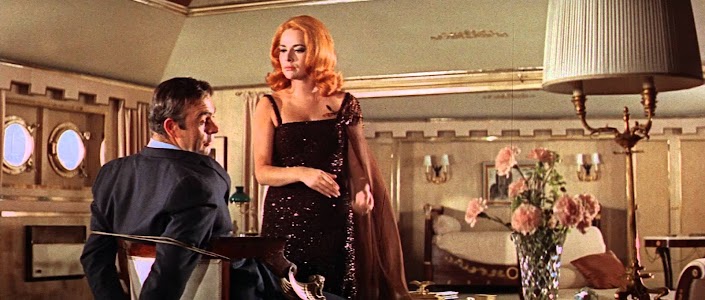
There was also some really fabulous fashion in YOLT--Bond’s black and white wingtips (I only caught a glimpse while he was running away from someone.  It would have been easy to miss them, but they were so cool and somewhat unexpected from the dapper yet classically sophisticated Bond), Aki’s bluedress, and this amazing sequined number on Helga Brandt, aka SPECTRE agent No. 11.  I think my most vocal reaction during the entire movie was when Bond actually cuts that beautiful dress with a knife (to more easily undress her, of course. Ugh!)--what a crime to fashion.

But enough about YOLT, let’s talk about On Her Majesty’s Secret Service and George Lazenby, who will probably forever be remembered as the guy who only played Bond once.  I was quite surprised by how much I liked Lazenby in the role, and it was more than just a welcome relief from Connery.  Lazenby, for someone who apparently had done little to no acting before being cast, gave a solid performance and was much more relatable than Connery.  He came off as less suave and sophisticated, more rugged and attractive, casual.  Maybe that is an indication that we are moving into the late ‘60s and early ‘70s when a general informality took over culturally, but until I see Connery’s return in the next movie, I will attribute it to Lazenby’s skills on screen.  And while I don’t completely understand why he and Tracy fall in love, once it’s established that they are in love, I actually believe it to be true (that being only slightly marred by the whole sleeping with Blofeld’s “angels of death” - I guess we’re supposed to believe “out of sight, out of mind” or something like that when it comes to his love for Tracy; or that he’s doing it for Queen and Country maybe).  The last scene is a heartbreaking close to a movie, but surprisingly believable given Bond’s reputation.  I might go so far as to say that Lazenby is a better actor than Connery, who mostly seems to get by on his looks, but Connery is so clearly better at the one-liners and had a much more prolific career, so I think I would be stretching it if I actually endorsed that comment.  But the special features show every exec who worked with Lazenby saying that he could have been the best Bond, so there must be something there.  So far, I agree with them. 

I think, for me, part of the appeal of Lazenby as Bond is that his Bond was somewhat less offensively sexist.  Don’t get me wrong, he’s still a pig, and the violence against women--in this case, Tracy--was quite appalling.  Don’t even get me started on the reason Draco gives for why he wants Bond to marry his daughter.  But there are small redeeming moments in this movie.  When Tracy offers to pay off her debt from the gambling table but hesitates, Bond clearly says she owes him nothing and means it.  He doesn’t just make a joke about it and continue as if nothing is bothering her, as I could see Connery’s Bond doing.  And when Bond does go to seduce Blofeld’s "angels," it seems to be largely because the women were throwing themselves at him rather than the other way around.  I’m not so sure it excuses his behavior completely, but it’s something different from the approach of Connery as Bond (and yes, I know Bond’s approach has everything to do with the writing and not necessarily the actors, but you can’t completely discount the tenor and tone each actor brings to the character).

Beyond Lazenby’s distinct interpretation of Bond, here are some thoughts on the movie more generally:

These movies are entirely too long, and OHMSS seemed especially disjointed as a story.  It took an hour and half to reveal Blofeld’s evil scheme, and then there was never any real threat that he might pull it off.  Besides the fact that he is SPECTRE’s No. 1 agent, I felt no real threat to mankind in this one like there was in all previous films.  That said, I was beginning to wonder if we would ever move away from the very-Cold-War-esque atomic plot lines to something more innovative and modern, and the germ warfare idea, even if not fully played out, was a welcome step in that direction. 

OHMSS had some very memorable high points and humor, which I appreciated and felt had gotten stale with Connery.  And some of those deaths are seriously grotesque - super high falls, red snow as a guy is chopped to pieces by a snowblower (But that joke, “he had a lot of guts,” seriously had me cracking up.  I still crack up every time I think of it.  Does that make me a horrible person?).  There were many quite violent fight scenes in the beginning and of course a big, extended chase at the end - it was in the middle where it dragged. 

As in YOLT, the fight scenes have gotten quite good, much better choreographed and executed.  Although, in OHMSS I felt like the editing of the fights had a 1960s-TV-Batman feel to them.  Kind of like stop motion but without the interjection of the “Wham!” or “Pow!”  I’m not saying this is a bad thing, just something I noticed. 

Interesting that the only black actor isn’t allowed to speak, only grunt.

I was beginning to think being filmed in a bikini (and almost always a white bikini) was a requirement to be an official Bond girl, but things being set mostly in the cold, snowy Alps, Tracy doesn’t wear one--a welcome relief. 

I sometimes get confused as to why Bond is in a certain place at a certain time, but one thing I do appreciate about the international nature of Bond is the films’ attempts to bring in the culture of the different countries in which he’s working: Nassau’s Junkanoo in Thunderball, Japanese Sumo wrestling in YOLT, bull fighting when OHMSS is in Portugal and winter sports when it heads to Switzerland. 

Finally, what exactly is Bond’s relationship with Monneypenny?  Does she love him?  She seemed seriously sad to see Bond get married, but yet it always seems tongue-in-cheek when she banters with him in the office.  He certainly doesn’t love her. . .


Saturday, May 18, 2013

Let's Talk About Thunderball


You Only Live Twice is set to record on my DVR on Sunday night, and the library's copy of On Her Majesty's Secret Service is sitting on my coffee table patiently waiting its turn (taunting this viewer who is impatiently waiting for the chance to see a Bond other than Connery).  In the meantime, let's talk about Thunderball.
I like to watch each movie, form my own opinion about it, and then educate myself about them with whatever is available in the DVD's special features section (which makes watching on DVD preferable to cable, if not always timely).  Upon finishing Thunderball, my impression was that it was not as good as Goldfinger but better than Dr. No.  Because, no matter how angry certain scenes in Goldfinger made me, as 1960s Bond action flicks go (so far as I know), it was pretty good, and let's face it, pretty much anything is better than Dr. No (at least at this point).  As far as story goes, Thunderball was about on par with From Russia, with Love, but oh my goodness, when it comes to pacing that story, Thunderball was boring.

It starts off exciting enough--Bond escaping from some goon with a jet pack and all (and I really enjoy the Thunderball theme song sung by Tom Jones), but the opening scene has nothing to do with the rest of the movie, which consists almost completely of villainous diabolical planning and build up for an extended underwater fight scene and boat chase at the end.  Bond manages to get himself out of some tricky situations in between, but after the opening scene the only real exciting action came with the big boat chase at the very end--I especially liked it when Domino got to kill the bad guy.  The underwater aspects were an interesting change of pace, but honestly, underwater fighting is incredibly slow and not at all exciting.  It just goes on forever.  And the idea of drowning is uncomfortable for me to watch since I was pretty terrified of it as a kid.
 
I was really tired of Thunderball by the time it was over, but I kept watching and educated myself--and was totally surprised by what I learned.  Apparently, Thunderball was the biggest Bond of the 1960s, in terms of scale, budget, and revenue.  It not only grossed incredible amounts at the box office; if the special documentaries on the bonus disc are to be believed, it was a huge global phenomenon, and not just at its initial release.  It was re-released at least two times as a double feature with From Russia, with Love and You Only Live Twice.  Meaning, people didn’t just go see it because they were curious/excited about a new Bond movie; they went to see it more than once because they enjoyed it.  And it was supposedly Thunderball that spawned a market for all kinds of Bond merchandise.  

It being the only film, so far, to come in a double-DVD set should have been some sort of tip-off, but I never would have guessed it had that kind of success.  I had never even heard of Thunderball before this project.  And if the hold lists at the library are any indication, it hasn’t retained its former popularity.  Unlike Goldfinger, which still has 15 requests on two copies (they got a new copy since I left the line), Thunderball always has at least one of its 5 copies available and I’ve never seen any holds on it.  Even You Only Live Twice has four holds on it.  I suppose in terms of special effects and general scale of production, Thunderball was innovative for the time, especially the underwater footage, which they talk about in the documentaries.  But those sequences were in great need of some editing, as far as I’m concerned.

Have you seen Thunderball?  What are your thoughts on the "biggest Bond of the 1960s"?  Am I missing something that makes it really special?

Tuesday, April 23, 2013

OMG! (Oh My Goldfinger!)


After watching the second Bond film, From Russia with Love, shortly after Dr. No, I got a bit hung up trying to acquire Goldfinger.  I think its central role in the Oscars tribute must have contributed to its popularity at the library because I was the 22nd hold when I first put in the request on the library’s single copy of the film.  More than a month later, I’m still number 14 in line, so we paid to rent it on our new cable plan. 

I’ve had almost a week to digest the film, and I still can’t get over how truly disgusted and appalled I am with the misogyny of James Bond.  It seems to be getting progressively worse in each film, and if I hadn’t already committed myself to this project, I feel like I otherwise would have declared Goldfinger the last Bond film I would ever watch.  Seriously, when it comes to womankind, James Bond is the enemy in this film, not Goldfinger. 

I thought it was bad when in From Russia with Love, they had two women literally fighting like animals for the love of some man, but in Goldfinger we see James Bond use a woman he’s just had sex with as a human shield (I don’t really care if she is working for the enemy); then we see the credits with images projected over parts of a woman’s body (same concept as the credits in the previous film); then he “playfully” pushed a woman away by the face while trying to talk on the phone; then he can only look at Pussy Galore as a sexual object he needs to consume even though she’s an obviously talented and successful villain and should be a serious threat to him; then he proceeds to force her into sex after she says no multiple times and physically fights with him to keep him off her and prevent him from kissing her.  How are we supposed to believe she just melts as soon as he manages to get his lips on hers?  All I could think for the next two days was, “did I just see James Bond rape Pussy Galore?”  Bond’s joke about Pussy calling Washington because he “must have appealed to her maternal instincts” was really the last straw. 

Forevermore, in my mind, Sean Connery will be the Bond who forced himself on Pussy Galore - he’s definitely not my favorite Bond after that.  Bond is no longer suave and cool; he’s just a pig.  To think that after From Russia with Love I was complaining about these Bond films being rated only PG and how I thought Bond was all about hot and sexy but we had yet to see any of that.  I honestly found Goldfinger hard to watch at certain moments because of Bond’s attitude toward sex and women.  I know it’s a long shot, but will someone please tell me that Bond evolves over time to acknowledge feminism and become at least a little more enlightened when it comes to women. 

I mean this man is completely obsessed with sex and his own sense of sexual entitlement, to the point that it’s interfering with his job.  It’s all he thinks about.  He even cracks jokes about it and at one point in the film has to take deep breaths and remind himself about “discipline” to prevent himself from chasing after a women who is speeding past him in a car.  And while his male colleagues seem to just go along with it and crack jokes about his way with the dames, I find it interesting that these aren’t always positive responses.  In some ways it comes off as jealousy; in others it is clearly a frustration with how his preoccupation obviously interferes with his work.  It’s telling that when Bond is in his most vulnerable position, that laser beam is headed straight for his crotch.  But why these enemies never just shoot him dead when he’s passed out in front of them will forever escape my understanding.

Misogyny aside, in the two films since Dr. No, James Bond--both the character and franchise-- seems to have come into his own.  The production quality is better with bigger explosions, more fire, smoke, and urgency, even if the acting and choreographed fight scenes still seem a bit stilted at times.  Watching Goldfinger in HD really helped--the colors are incredibly saturated compared to the usual drabness you get with 1960s color quality.  The iconic Aston Martin not only looks great; it does some pretty awesome stuff.  And Bond has access to more and more nifty gadgets, even though he always seems to have at least one scene where he tricks the enemy by hiding on the ceiling and attacking from above.  Bond’s international reputation and plot lines remain in place, but with Goldfinger it was either a simpler plot or I’m becoming better at following them.  Yet, of all the unbelievable an implausible plot lines and twists these Bond films have, I think Goldfinger, is definitely the worst so far.  The basic scheme that they’re working to stop just would never work.  I can’t remember the specifics of what was so unbelievable, but there were definite moments when we couldn't not laugh.

I’ve already checked Thunderball out of the library, so hopefully there won’t be as much lag time before the next update.