Monday, October 7, 2013

Broody Bond

Overall, I feel like there’s not much to Timothy Dalton as James Bond.  He does not have an especially imposing presence on screen; he’s not particularly attractive compared to his Bond counterparts (although by no means unattractive); and the two films in which he starred were, in my opinion, middling in terms of overall quality. 

After 13 Connery and Moore films filled with condescending sophistication, rampant womanizing, witty one-liners, and a good deal of campy kitsch, Dalton’s Bond seems oddly quiet and brooding.  He doesn’t say much, and when he does it is not especially powerful.  He’s not as skilled with the humorous quips, nor does he seem to demand the authority, charm, or sophistication of the Bonds who came before him.  It was, in fact, quite strange to see Bond in a bulky leather jacket and knit sweater, rather than a suit, for much of The Living Daylights


His character, especially in Licence to Kill, moves from one extreme to another--at one moment a brutally violent killer, the next a flirtatious and sweet companion.  Granted, I like the dimension more emotion can bring to the character of Bond.  Who knew Bond could be so driven by sentiment, when he goes rogue to avenge Felix?  And I kind of like that he and Bouvier are flirtatious with each other.  It was much more believable than Bond’s typical “I deserve to have you” attitude, the “we just survived a crazy mission, we should obviously have sex now” pattern of Moore’s films, or Dalton’s unconvincing sappiness and swooning over Kara in The Living Daylights (those two had some of the worst on-screen chemistry I have ever seen; not to mention, it is nearly impossible to believe that in 1987 Bond would be attracted to a woman so completely dependent and ineffectual).  Moving between extremes might bring more interest to Bond, but the maneuver ultimately lacked subtlety and nuance, and for me, Dalton does not successfully convey a naturalness in either gear.   

Dalton’s take on Bond was quite a jarring departure from Connery or Moore.  I can understand how a generation who grew up on either of those two actors in the role might resist Dalton, relegating him to the bottom (always just above Lazenby) on any number of online polls of the “best Bond.”  After Connery and Moore, you expect Bond to be larger than life, rather than fading into the background; cocky and quick-witted, not brooding and humorless; indifferent to his female conquests, not adoringly sentimental and practically monogamous (admittedly, as I have read elsewhere, this lack of promiscuity--he only sleeps with one woman in The Living Daylights, two in Licence to Kill--is attributable to an historical context dominated by the relatively early years of an AIDS epidemic). 

There are those who, having gone back to view Dalton’s films with a new eye, point out that he was actually ahead of his time and predated Craig’s darker portrayal of 007, arguing that Dalton should be viewed as the best Bond ever (see, for example, this article or this one).  But while they claim Dalton as the best Bond, their claim hinges on an argument that Dalton’s interpretation of Bond is merely the most authentic to the Bond created by Fleming in his original novels.  In my opinion, this is not a solid base on which to rest one’s claim.  Granted, I have never read any of the Bond books, so I cannot make any kind of judgment about an actor’s authenticity to them, but I imagine most of the people who watch Bond films have also never read the books.  So shouldn’t the film Bonds be judged on their own merits, rather than compared to the Bond in Fleming’s books?  Also, if the movies are not authentic to the books--from what I have gathered, nearly all of them simply take their titles, a few character names and plot points, and pretty much completely re-write the story--then why should an actor’s portrayal of Bond be judged on his allegiance to the books?  Even more significant, only one of the books that bear the titles under which Dalton stars, The Living Daylights, was written by Ian Fleming.  The other, Licence to Kill, was written by a John Gardner.  So to defend Dalton’s portrayal of Bond as the best because it is closest to Fleming’s envisioning of the character seems to me to be little defense at all.  

However, everyone is entitled to his/her own opinion.  If someone prefers a more broody, sentimental Bond, so be it.  But someone could also argue that Bond is best when womanizing, cracking jokes, and always wearing beautifully cut suits with a dashing smile.  I simply feel like Timothy Dalton did not inhabit the role of Bond in the same way that his predecessors did.  He never felt completely comfortable in the role from what I could see and failed to make it his own or make a real impression at all. 

A few other thoughts on the films overall:

The technology has definitely improved with the times--wireless phones, desktop computers, and some seriously heavy weaponry.  It makes me wonder if the Bond franchise is reaching a point where the crazy gadgets that made Bond cool in the ‘60s will soon make little impact as they become merely reality rather than futuristic fantasy.  It has also contributed to some exceptionally gruesome death scenes and major violence in recently viewed films.

While I was not a particular fan of Dalton’s Bond, I think that part of the reason he is less praised than others is the fact that his films are less likely to be played on television, especially The Living Daylights.  The history surrounding Britain and America’s role in Afghanistan and with the Mujahideen is problematic today, at best.  But watching it forced this ignorant and confused viewer to read up on that history and actually learn something.  And while I say “play it all the time; educate our populace!”, perhaps that’s exactly why it’s not played--it’s probably not a history America is comfortable fessing up to on network or cable television on a regular basis. 

I have a problem with the choice of actress to replace Lois Maxwell as Moneypenny.  At least Maxwell was obviously older than any of the girls Bond slept with, and I could use that as a reason for why Bond might not take advantage of her also--she could be seen as either “over 30” and therefore unattractive in Bond’s entitled mind or as something of a mother figure in later movies.  As much as I hate to admit it, Caroline Bliss is simply not right for the role because she is far too attractive.  Without those glasses she is totally Bond’s type, and it is hard to believe that Bond would not be seducing her any chance he gets.  I guess I have to work on believing that Bond is actually capable of caring for a woman without wanting to sleep with her--that Moneypenny is maybe like a sister to him?

Tuesday, September 10, 2013

Roger Moore Review

A collection of thoughts on the seven films in which Roger Moore plays the character of James Bond (incomplete and in no particular order):  
  • The very first thing I noticed: when Bond steps into the gun barrel and prepares to shoot, he is no longer wearing a fedora and is now wearing flared pants.  Bond is definitely a character that changes with the times.
  • Moore’s is a more casual Bond in general, but while he is clearly differentiated from Connery in the early films, he becomes increasingly snobby, condescending, and sexist in later ones.  And I didn’t like the ways they tried to differentiate him from Connery--why was Bond smoking cigars and drinking whisky?  Going back to cigarettes and martinis was definitely the right move, even if bringing back the nasty, sexist attitude was not.
  • It took one or two films for disco to really influence the soundtrack, but once it did the discofied Bond theme in those few films was awesome!  It’s too bad that same disco influence didn’t really carry over to the title songs.  After “Live and Let Die” by Paul McCartney and Wings the title sings got worse with each outing until “A View to a Kill” by Duran Duran, which closed out the Roger Moore era.  Slow and saccharine were not words I ever thought I would use to describe Bond music until I heard these monstrosities.
  • One major development that also made “A View to a Kill” perhaps the best Bond title sequence yet: the women/female silhouettes were actually wearing clothes - at least enough clothing to cover their more private pieces.  And there was a straight on shot of Bond’s face in the title sequence, which was a bit jarring, along with male silhouettes.
  • The bright neon and blacklit colors of the title sequence in A View to a Kill screamed ‘80s in the same way Live and Let Die exemplified the 1970s.  It was interesting, though, that the outrageous ‘80s fashion sensibility was only present in the actual film with the character of May Day, played by Grace Jones.
  • I’m going to put it out there: Christopher Walkin was actually quite good looking as a young man.  I kept thinking how much he could have passed as a member of a boy band.  It took me by surprise having only seen his later films.
  • Roger Moore, on the other hand, was not so young by the end of his Bond run.  Let’s face it, he was not young when he started playing the role.  By the end of 12 years, he was really starting to look old.  It was quite impressive he could still do as much physical acting as he did.
  • According to the DVD leaflet with The Spy Who Loved Me, “the designated Bond girl is much more . . . not only Bond’s ally in the film, she is just as intelligent, lethal, and resourceful as 007,” which supposedly “signaled a new era for the series--one in which Bond’s paramours would have increasingly accomplished resumes--and reflected to changing role of women in society in the wake of the modern women’s liberation movement.”  If I stretch, I might believe this to be the case in The Spy Who Loved Me, but really, besides the fact that Triple X was a fellow agent (of the KGB), she wasn’t that much more effective than some previous Bond girls, especially Tracy from On Her Majesty’s Secret Service or Pussy Galore in Goldfinger.  I had similar reactions to the Bond girls in Moonraker, For Your Eyes Only, and Octopussy.  Stacey Sutton in A View to a Kill was just as inept as any previously ineffective Bond girl, while May Day, a stronger character, was the villain cast in stereotypes, sexuality and exoticism.  Ultimately, for every “increasingly accomplished” Bond Girl there are a handful of other women in the films whose only role is to take orders and look pretty.
  • My ideal Bond girl is not only “as intelligent, lethal and resourceful as 007 himself”; she is also capable of being just Bond’s professional colleague who does not feel the need to jump into bed with him just because the mission is completed successfully.  She actually recognizes and calls Bond out on the sexual harassment he inflicts upon her.  By the middle of the Moore era you could easily predict that the final words of the film would be a Bond Girl sighing the words “Oh, James”--so annoying.  Isn’t it sad that I should be so impressed that Bond somehow maintained enough scruples to not sleep with 18-year-old BiBi in For Your Eyes Only?  
  • So disappointing that the only explicit mention of the women’s movement in any of the films 1) did not come until A View to a Kill, in 1985, the height of backlash and 2) was made in the context of a joke - in response to the odd look Stacey Sutton gets wearing stilettoes with her construction jumpsuit Bond says, “It’s women’s lib, taking over the teamsters.”
  • Turns out it was beneficial to watch all of Moore’s films in relatively quick succession and in order.  I recognized the Sherriff from Live and Let Die when he returned in The Man with the Golden Gun.  I could identify enough with Jaws after seeing him in The Spy Who Loved Me to cheer him on when he went from villain to hero in Moonraker.  I was able to pick out the running joke of an Italian tourist shocked by Bond’s crazy vehicles in three sequential films.  And I knew why M was “on leave” in For Your Eyes Only: the actor who played him in previous films had died.  (the new M is not as good).
  • Also beneficial was that having previously seen OHMSS I picked up on the significance of Bond’s pre-title visit to the grave of Teresa Bond that led to a helicopter chase with Blofeld.  I was actually quite surprised that they returned to Bond’s marriage plot line and disappointed when they dropped it completely after the titles.
  • While I’m curious what Ian Fleming’s original stories are, I’m happy that the Bond films change them to keep with the times.  The themes of energy crisis, détente, and microchips warm my historian’s heart.  (The parody of Margaret Thatcher at the end of For Your Eyes Only did not, although it was a crazy coincidence that we had just watched The Iron Lady the night before).
  • The Man with the Golden Gun totally sucked when it comes to gadgets, but I loved the spy gadgetry in the other films--and that Q seems to have a lab set up in any exotic locale Bond finds himself in, as does M seem to set up an office in the craziest of places.  Of all the awesome gadgets, the Lotus Esprit submarine car in The Spy Who Loved Me was the coolest of them all, especially since we had just seen it parodied in Despicable Me 2 a few nights earlier.  Speaking of, this news item from the last 24 hours is relevant (another crazy coincidence!  I just randomly came across it when googling for the real name of “James Bond underwater car”).
  • My overall impression of the Roger Moore era is that the films had become highly formularized.  This is not necessarily a bad thing, and it might just be that I am finally picking up on the formula after having watched so many.  But formula does tend to grow stale after a while, so here’s hoping that a new leading man will inject some energy into the series for me (I get the sense that I probably shouldn’t count on that with Timothy Dalton, but who knows?).
What are your thoughts on the Roger Moore Bond films?  

(Also, three cheers for reaching a remaining film count in the single digits!)

Thursday, August 22, 2013

Welcome to the 1970s

This post was meant to be a well-reasoned, thought-provoking analysis of Live and Let Die.  Alas, as it has been more than a month since I screened the film, this quick run-through of my thoughts on what I remember will have to do.  I’ve also managed to view four more Roger Moore Bond films in the intervening time, and I wanted to blog about Live and Let Die before blogging my thoughts on the Roger Moore era as a whole.   

From what I have gathered over the years, Moore competes with Connery as people’s definitive James Bond.  I have decided to withhold judgment on Moore for the time being, but I could not let Live and Let Die be seen without at least some sort of commentary. 

With Live and Let Die we jumped head-first into the 1970s.  If you are at all curious about the fabulous fashions, tired clichés, and general feel of 1970s pop culture, watch this film.  Not only does it feature this amazing rainbow sequined dress (a precursor to the glamorous disco dresses that would become de rigueur in dance clubs and on music stages just a few years hence), a collection of flamboyant (some might say “pimpin’”) male suits and accessories such as this polka dot scarf, and a number (see 5 links here) of outstanding outfits on a young Jane Seymour; even the conservative and classic James Bond gets in on the ‘70s fashion foppery with outfits like this powder blue leisure suit


In many ways, the 1970s fashions and feel are rivaled in film only by the Blaxploitation genre on which this Bond appears to be based.  Yet, one major aspect (and many smaller ones) of Live and Let Die makes it fundamentally different from a 1970s Blaxploitation film.  Yes, the writers changed Ian Fleming’s story about the smuggling of gold coins to one about an international Heroin ring so as to fit with the common Blaxploitation tropes of drugs and crime in black communities.  Yes, there are a number of scenes set in urban black communities, most notably New Orleans and Harlem.  And yes, the film features a cast of larger-than-life black characters who are empowered and violent.  But key to the grand majority of 1970s Blaxploitation films is the black vigilante hero--be it man or woman--who is empowered to save/enact revenge/conform his or her community/family/race from some form of evil--white supremacy, drugs, prostitution, etc.  It is the black character who saves the day, be it from the criminals in his own community or from the white suppression of his race.  A black character is the hero.  It was, and remains today, an important anomaly in film that the black character saves the day or enacts violent revenge, actions that are overwhelmingly relegated to white men. 

The fact that all black characters in Live and Let Die are villains (save one black agent who gets killed) and James Bond is the hero, criminalizing Mr. Big and his black minions, makes the film an exploitation of the success of Blaxploitation rather than a true homage to it.  (Honestly, it makes me wonder if they chose to imitate the genre only to make it somehow a more acceptable setting for Bond to bed his first black woman.)

Yet, it seems the producers of the film were well aware of this problem when they were making it.  As the director (writer? producer? I can’t recall) said plainly in the special features documentary, “Inside Live and Let Die,” with all the black actors being villains, you know they’re going to lose, so who else can we make fun of? (paraphrasing here).  So they brought in the character of the bumbling redneck southern Louisiana sheriff, so poor southern whites could also take some of the racist brunt--equal opportunity racism, as my friends and I called it. 

And being aware of the racism, stereotyping, and absurdity of it all, actually makes the film rather enjoyable and humorous in its ability to appall and enthrall.  A syndicate of black drug smugglers so powerful that it seems every black person from Harlem to New Orleans to the Caribbean is involved?  A black cabbie who quips, “for $20 I’ll take you to a KKK cookout”?  Mr. Big’s lackey, the voodoo leader, portrayed as a constantly smiling Sambo?  The exoticism, spiritualism, and voodoo of the residents of the fictional Caribbean island of San Monique on display throughout the film (although it was unclear to me how much of it was supposed to be understood as genuine vs. how much was meant for the purpose of tourism)?  And, of course, that overly long and outrageous boat chase in the Louisiana swamps with the completely inept southern white cops trying in vain to catch the drivers?  All so absurd as to be humorous. 

There were some genuinely humorous moments in the film as well, even if Bond’s quips and sexual innuendo were a bit out of control in this outing.  There was also plenty of action on land, sea, and air and a variety of nifty gadgets that made the movie enjoyable to watch.  Certainly not the best Bond film in terms of realism, structure, and general cinematic quality, but Live and Let Die was good enough to keep my attention and enthusiasm for almost the entire 2+ hours, which is a major accomplishment for a Bond film so far.  

Saturday, June 8, 2013

Finally, a New Bond

Finally, after the over-the-top, hard-to-swallow plot twists of You Only Live Twice, we have On Her Majesty’s Secret Service, which while having its own moments of incredulity, also humanizes James Bond in unexpected ways.  Both movies prove my idea that action happening on solid ground--hand-to-hand combat, chases on skis or in cars, explosions--are all more exciting than anything underwater, but I’m becoming convinced that Bond movies are just not my cup of tea.  I feel like, after Thunderball especially, as long as there are a few really cool fight scenes, fast chase scenes, and at least one big explosion the Bond film has met my expectations. 

I read somewhere that Roald Dahl abandoned most of the original novel’s plot in writing the screenplay for You Only Live Twice.  If that be the case, combining the Cold War with the Space Race in developing the evil plan may have been his downfall.  The premise often seemed more like science fiction than any kind of reality.  That couldn’t possibly be what people actually thought of the space race and what it might achieve; or is it?  And that problematic premise doesn’t even get at Bond rising from the dead without any real explanation as to how he/they pulled off his faked death ruse or why he needed to “become Japanese” in order to stop Blofeld and SPECTRE’s plan from happening.  (FYI, a shaved chest, different hairstyle and kimono do not “make” one Japanese.  I wasn’t sure if we were supposed to believe he was trying to pass as Japanese physically or just culturally. Why couldn’t he just “become a ninja”--a British Ninja Warrior?)  Overall, You Only Live Twice was not the best Bond movie ever made. 

That being said, there were some interesting developments.  We finally got to see SPECTRE agent No. 1, aka Blofeld, but Telly Savalas played the character much better in On Her Majesty’s Secret Service.  But why did they get rid of the scar on the side of Blofeld’s face in the latter?  I’m assuming that because they made a point to show how he wasn’t actually dead at the end of OHMSS, that we will be seeing this villain again.  Although, honestly, I would be perfectly happy to only ever see Blofeld represented through his cute white cat, which we got to see quite a lot of in YOLT

The gadgets in YOLT were also pretty cool--that mini helicopter, especially, even if it did bother me how they not only referred to it with a girl’s name (standard, no trouble there), but talked about “Little Nellie” having fought off “improper advances” and “defended her honor,” placing me back in the misogyny of the era.  It also bothered me that some of Bond’s gadgets, like his mini-rocket cigarettes, were developed by someone other than Q.  I was actually offended.  I think because I’ve come to really like Q.  He always calls Bond out on his sh*t, and his gadgets are pretty much the only reason Bond is ever able to get out of these messes.  I think Q is my favorite recurring character. 

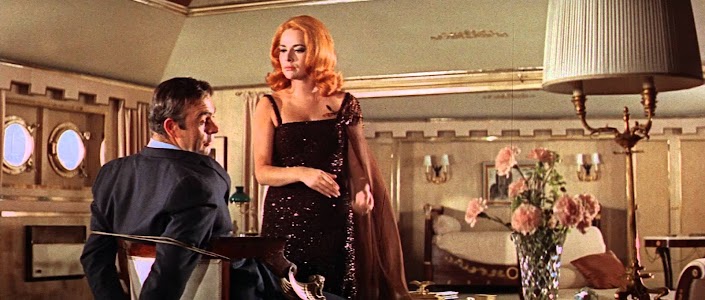
There was also some really fabulous fashion in YOLT--Bond’s black and white wingtips (I only caught a glimpse while he was running away from someone.  It would have been easy to miss them, but they were so cool and somewhat unexpected from the dapper yet classically sophisticated Bond), Aki’s bluedress, and this amazing sequined number on Helga Brandt, aka SPECTRE agent No. 11.  I think my most vocal reaction during the entire movie was when Bond actually cuts that beautiful dress with a knife (to more easily undress her, of course. Ugh!)--what a crime to fashion.

But enough about YOLT, let’s talk about On Her Majesty’s Secret Service and George Lazenby, who will probably forever be remembered as the guy who only played Bond once.  I was quite surprised by how much I liked Lazenby in the role, and it was more than just a welcome relief from Connery.  Lazenby, for someone who apparently had done little to no acting before being cast, gave a solid performance and was much more relatable than Connery.  He came off as less suave and sophisticated, more rugged and attractive, casual.  Maybe that is an indication that we are moving into the late ‘60s and early ‘70s when a general informality took over culturally, but until I see Connery’s return in the next movie, I will attribute it to Lazenby’s skills on screen.  And while I don’t completely understand why he and Tracy fall in love, once it’s established that they are in love, I actually believe it to be true (that being only slightly marred by the whole sleeping with Blofeld’s “angels of death” - I guess we’re supposed to believe “out of sight, out of mind” or something like that when it comes to his love for Tracy; or that he’s doing it for Queen and Country maybe).  The last scene is a heartbreaking close to a movie, but surprisingly believable given Bond’s reputation.  I might go so far as to say that Lazenby is a better actor than Connery, who mostly seems to get by on his looks, but Connery is so clearly better at the one-liners and had a much more prolific career, so I think I would be stretching it if I actually endorsed that comment.  But the special features show every exec who worked with Lazenby saying that he could have been the best Bond, so there must be something there.  So far, I agree with them. 

I think, for me, part of the appeal of Lazenby as Bond is that his Bond was somewhat less offensively sexist.  Don’t get me wrong, he’s still a pig, and the violence against women--in this case, Tracy--was quite appalling.  Don’t even get me started on the reason Draco gives for why he wants Bond to marry his daughter.  But there are small redeeming moments in this movie.  When Tracy offers to pay off her debt from the gambling table but hesitates, Bond clearly says she owes him nothing and means it.  He doesn’t just make a joke about it and continue as if nothing is bothering her, as I could see Connery’s Bond doing.  And when Bond does go to seduce Blofeld’s "angels," it seems to be largely because the women were throwing themselves at him rather than the other way around.  I’m not so sure it excuses his behavior completely, but it’s something different from the approach of Connery as Bond (and yes, I know Bond’s approach has everything to do with the writing and not necessarily the actors, but you can’t completely discount the tenor and tone each actor brings to the character).

Beyond Lazenby’s distinct interpretation of Bond, here are some thoughts on the movie more generally:

These movies are entirely too long, and OHMSS seemed especially disjointed as a story.  It took an hour and half to reveal Blofeld’s evil scheme, and then there was never any real threat that he might pull it off.  Besides the fact that he is SPECTRE’s No. 1 agent, I felt no real threat to mankind in this one like there was in all previous films.  That said, I was beginning to wonder if we would ever move away from the very-Cold-War-esque atomic plot lines to something more innovative and modern, and the germ warfare idea, even if not fully played out, was a welcome step in that direction. 

OHMSS had some very memorable high points and humor, which I appreciated and felt had gotten stale with Connery.  And some of those deaths are seriously grotesque - super high falls, red snow as a guy is chopped to pieces by a snowblower (But that joke, “he had a lot of guts,” seriously had me cracking up.  I still crack up every time I think of it.  Does that make me a horrible person?).  There were many quite violent fight scenes in the beginning and of course a big, extended chase at the end - it was in the middle where it dragged. 

As in YOLT, the fight scenes have gotten quite good, much better choreographed and executed.  Although, in OHMSS I felt like the editing of the fights had a 1960s-TV-Batman feel to them.  Kind of like stop motion but without the interjection of the “Wham!” or “Pow!”  I’m not saying this is a bad thing, just something I noticed. 

Interesting that the only black actor isn’t allowed to speak, only grunt.

I was beginning to think being filmed in a bikini (and almost always a white bikini) was a requirement to be an official Bond girl, but things being set mostly in the cold, snowy Alps, Tracy doesn’t wear one--a welcome relief. 

I sometimes get confused as to why Bond is in a certain place at a certain time, but one thing I do appreciate about the international nature of Bond is the films’ attempts to bring in the culture of the different countries in which he’s working: Nassau’s Junkanoo in Thunderball, Japanese Sumo wrestling in YOLT, bull fighting when OHMSS is in Portugal and winter sports when it heads to Switzerland. 

Finally, what exactly is Bond’s relationship with Monneypenny?  Does she love him?  She seemed seriously sad to see Bond get married, but yet it always seems tongue-in-cheek when she banters with him in the office.  He certainly doesn’t love her. . .